



Cataract Surgery
What No One Tells You About Modern Cataract Surgery
Shresht
December 31, 2025
Introduction
Cataract surgery is one of the most common, safest, and most successful medical procedures performed today. For many, it’s viewed as a straightforward fix for the cloudy vision that comes with age. But behind this perception of simplicity lies a world of surprising complexity, cutting-edge personalization, and fascinating biological details that are rarely discussed.
This isn’t just about removing a cloudy lens; it’s about making a series of highly personal decisions that will shape how you see the world for the rest of your life. Here are four impactful realities of modern cataract surgery that go far beyond the basics.
1. Your New Lens Isn't One-Size-Fits-All—It's Highly Personalized
The core of cataract surgery is replacing your eye’s cloudy natural lens with a clear, artificial intraocular lens (IOL). What’s surprising is that this IOL isn’t a standard, off-the-shelf part. It’s a sophisticated piece of technology that is carefully selected to match your unique eyes, lifestyle, and vision goals. There are three main categories to choose from.
- Monofocal Lenses: These are the most common lenses, often covered by insurance or the
NHS. They are set to provide clear vision at a single focal point, usually for distance. This
makes them ideal for activities like driving or watching TV, but you will almost certainly need
reading glasses for close-up tasks. - Multifocal Lenses: A premium option, these advanced lenses are designed with different
zones to provide clear vision at near, intermediate, and far distances. They significantly reduce or eliminate the need for glasses, with studies showing that 95% of patients with these lenses don’t need glasses for daily activities. - Toric Lenses: Astigmatism, caused by an irregular curve in the cornea, blurs vision at all
distances. For the one in three cataract patients who have significant astigmatism, these
specialized toric lenses are crucial. They are built to correct that irregularity, providing a
much sharper and clearer outcome. Crucially, these lenses can also be designed as either
monofocal or multifocal, allowing patients to correct their astigmatism while also choosing
their desired range of focus.
The choice of lens is a critical decision based on your hobbies, work, and what you value
most in your vision—whether it’s the freedom from glasses or the sharpest possible
distance clarity.
2. Laser vs. Manual Surgery: It's About Assistance, Not Just "Better" Technology
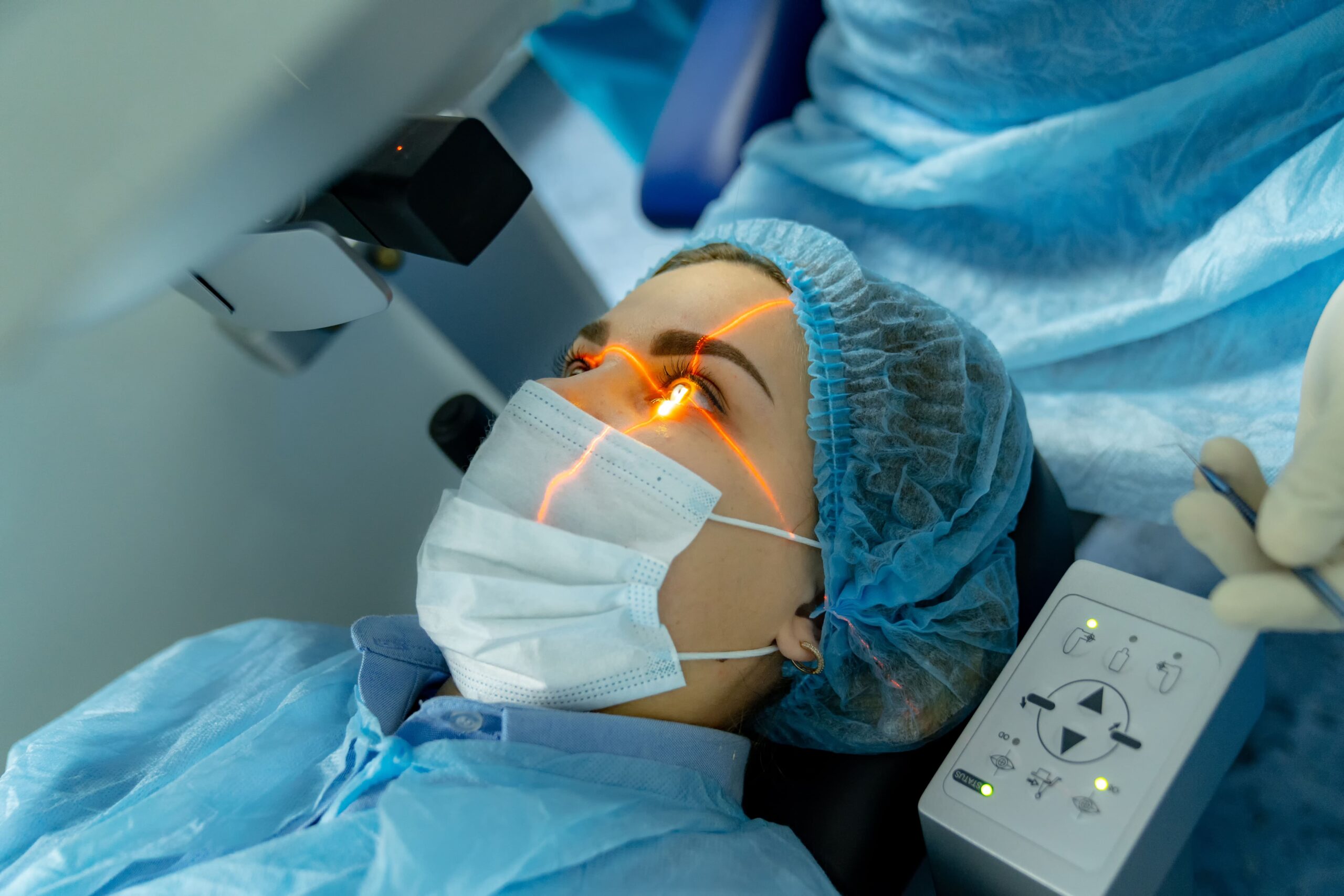
Many people assume that surgery involving a “laser” is automatically superior to a manual procedure. In the case of cataract surgery, the reality is more nuanced. Femtosecond Laser- Assisted Cataract Surgery (FLACS) doesn’t replace the surgeon; it assists the surgeon in performing several key steps with enhanced precision. The majority of the operation is still performed by hand.
Here’s what the laser can do:
- Incisions: The laser can create the initial incisions to access the eye. These cuts are designed to be incredibly precise and self-sealing, which is vital for maintaining pressure and safety within the eye.
- Capsulorhexis: To remove the cataract, the surgeon must create an opening in the thin
membrane, or capsule, that holds the lens. The laser can create what one surgeon calls a
“nice Perfect Circle,” which is critical for ensuring the perfect centration and stability of
premium multifocal or toric lenses. - Fragmentation: Before the cataract can be removed, it must be broken into smaller, more manageable pieces. The laser can pre-fragment the lens, which is especially helpful for very dense, mature cataracts or in complex cases like pseudoexfoliation where the eye’s internal structures are weaker. This requires less energy inside the eye during removal, potentially leading to faster recovery and less swelling.
Both manual and laser-assisted surgeries are exceptionally safe and effective, with excellent outcomes. The crucial takeaway is that FLACS is generally not covered by insurance and is an additional out-of-pocket expense. The decision is therefore a balance between potential clinical benefits in specific cases and the additional cost.
3. Your Brain Has to Re-Learn How to See
One of the most surprising facts about cataract surgery is that your vision improvement isn’t just a mechanical fix—it’s a neurological one. The process is called “neuroadaptation,” and it refers to your brain’s adjustment to the new visual information coming from the man-made IOL.
It typically takes 3-6 months for the brain to fully adjust and integrate the new lens after
decades of seeing through your natural one. During this time, it’s normal to experience
some visual fluctuations or a shimmering quality to your vision.
Patients who opt for multifocal lenses may notice halos or glare around lights, particularly at night. This is a well-documented part of the adaptation process. One study noted that halos
were reported in 29% of multifocal cases compared to just 8% with standard monofocal lenses. This isn’t a complication, but rather a side effect as your brain learns to process multiple focal points at once. For most people, these phenomena diminish significantly over time.
This powerful idea is a crucial part of setting expectations for recovery:
You’ve looked through a human lens (which became the cataract) for decades and now you’ll adapt to looking through a man-made lens.
4. Recovery is a Strict Regimen, Not Just Rest
While you can resume many normal activities within a day or two of surgery, the healing
process is governed by a strict and important regimen that goes beyond simply resting.
The most disciplined part of recovery is the eye drop schedule. Patients typically go home with three different types of drops—an antibiotic to prevent infection and two different anti-inflammatories to control swelling. These are administered on a tapering schedule, meaning the frequency decreases over time, but the full course can last for up to six weeks.
In addition to medication, there is a precise list of dos and don’ts designed to protect the
eye as it heals.
- Do not rub the eye for one week.
- Avoid swimming, hot tubs, and saunas for at least one week to prevent infection.
- Avoid jarring activities like jogging on hard pavement for one week.
- Avoid heavy lifting of items over 40 pounds.
It’s also common to feel a sensation like a “grain of sand or eyelash in the eye.” This is
completely normal and is caused by the microscopic incisions healing.
Conclusion
Far from a simple mechanical fix, modern cataract surgery reveals itself to be a deeply
personal journey—one defined by bespoke lens choices tailored to your life, a nuanced
decision between manual skill and laser precision, a remarkable period of your brain relearning to see, and a recovery that demands discipline, not just rest. By understanding these surprising realities, patients can approach their surgery as active participants, prepared to make the best decisions for a lifetime of clear sight.
Knowing that technology can offer freedom from glasses, how do you balance the cost of
innovation with the value of clear sight in your own life?

Cataract Surgery
December 31, 2025